

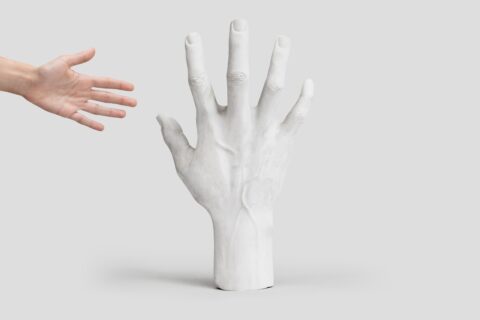
Défense de rien toucher
On the pediment of his work, as early as 1905, Ferdinand Cheval inscribed this phrase, as enigmatic as it is poetic: ‘Do not touch anything’ (Défense de rien toucher). A paradoxical invitation, hovering between prohibition and permission, to which Prune Nourry responds today with a resolutely generous proposal: an exhibition designed entirely to be touched.
With *Défense de rien toucher*, the artist transforms the Ideal Palace into a vast space for sensory exploration. Here, sight is no longer enough; it gives way to touch, to sensation, to the memory of forms captured by the palm. Accessible to everyone—children, adults, sighted and visually impaired visitors alike—the exhibition breaks free from museum conventions to re-establish a direct, physical relationship with the artwork.
This approach strikes a deep chord with the founding gesture of Ferdinand Cheval. A rural postman turned self-taught builder, originally trained as a baker, he literally ‘kneaded’ his Palace. Everywhere, the traces of the hand are evident: in the reliefs, the rough edges, the patient accumulations of material. By inviting visitors to touch her own works, Prune Nourry pays homage to this tactile and organic dimension of the Ideal Palace.
Having been presented to great acclaim at the Fondation Bullukian in Lyon, and ahead of its move to the Musée Camille Claudel in 2027, the exhibition marks a unique milestone in its ‘Empreintes’ touring programme. Set within this extraordinary venue, it embodies its spirit and extends its vision: a dialogue between cultures, between eras, and between imaginations.
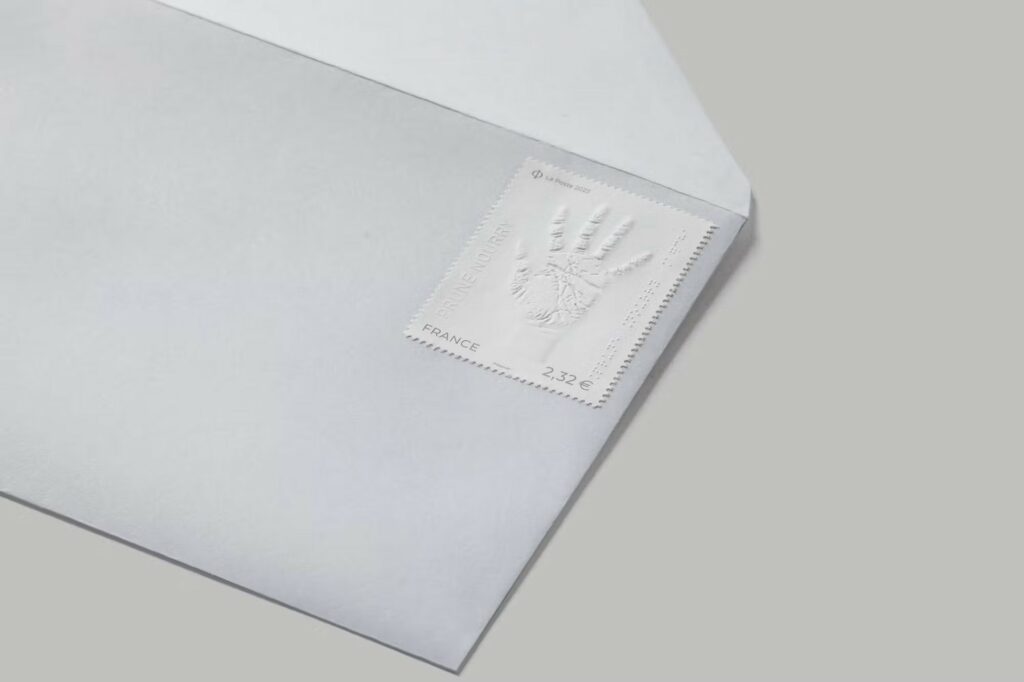
The exhibition opens with a postal-themed display, a nod to Ferdinand Cheval. A tactile stamp, designed by Prune Nourry in partnership with La Poste in 2024 (the first of its kind), opens the exhibition. Created in collaboration with blind and visually impaired people, it emerged from tactile experimentation workshops where shapes, textures and volumes were adjusted to be perceived by the fingers. More than just an object to be seen, this stamp is read by touch: it embodies a creation conceived in collaboration with those who experience it through their senses. This stamp also serves as the carrier of a letter addressed to Philomène, the Postman’s wife, a discreet yet essential figure without whom the Ideal Palace would undoubtedly never have seen the light of day.
Like the Palace itself, the exhibition unfolds as a miniature world, a crossroads of stories and cultures. The Terracotta Daughters and the Holy Daughters stand alongside other female figures, tracing a sensitive map of the body and identity across time and place. Without being a retrospective, Défense de rien toucher thus spans several of the artist’s major projects and offers an overview of her perspective on the female condition.
This work is also rooted in a deeply personal experience. In 2016, upon being diagnosed with breast cancer, the sculptor became acutely aware of the vital importance to her of touch, which was threatened by the side effects of chemotherapy. From this ordeal emerged a profoundly embodied artistic exploration of the body, healing and ritual. It was Agnès Varda, a close friend of the artist, who introduced her to the figure of the Amazons, heroines of Greek mythology who cut off their breasts to shoot a bow more effectively. Prune Nourry chose to incorporate this symbolic power into her work. The figure of the resilient, warrior woman thus runs through the exhibition.
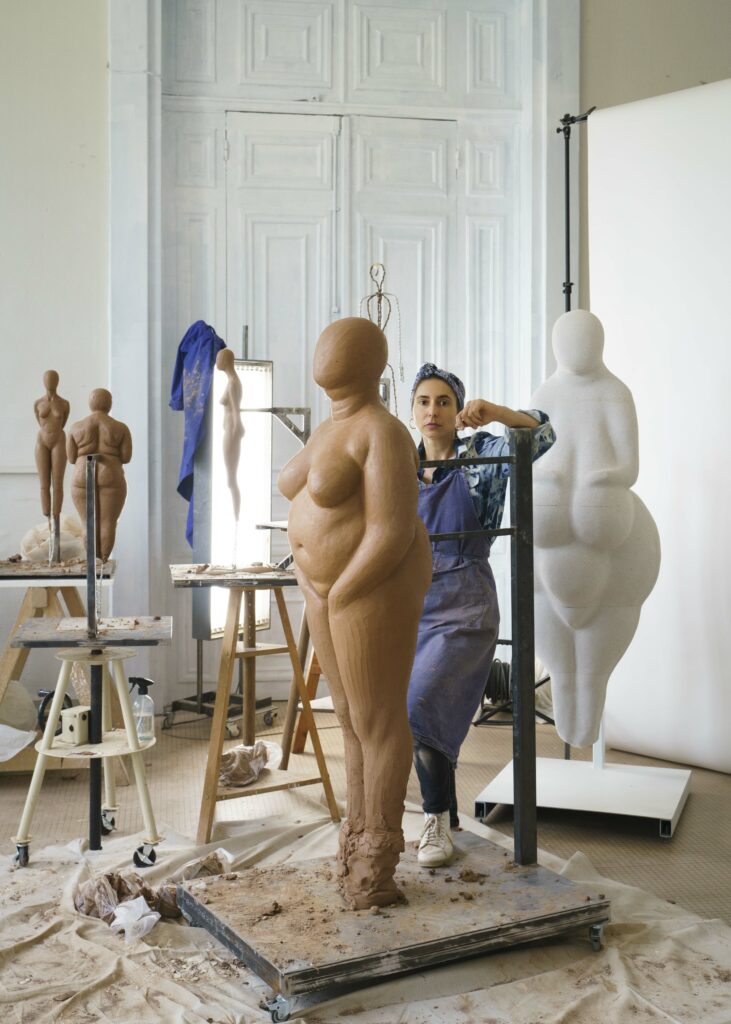
Outside the exhibition spaces, six bronze Venuses with earthen skin are installed in dialogue with the Palace. Set upon plinths reminiscent of the local rammed earth technique, they are inspired by the Palaeolithic Venuses of the Gravettian period (between 30,000 and 20,000 years ago) and stand tall as guardians of the Palace.
Created as part of a collaborative project with La Maison des Femmes, these sculptures are portraits of women from La Maison des Femmes, a women’s refuge in Saint-Denis for victims of violence. Shaped, marked and sometimes altered, these bodies bear the traces of time and tell a story inscribed in the very material itself: a story of scars, transformations and the life nestled within the folds of the skin. In autumn 2026, a life-size version of 108 Venuses will be permanently installed at Saint-Denis Pleyel station, as part of the Grand Paris Express project, in collaboration with architect Kengo Kuma. At the heart of each sculpture, a handful of earth will be placed; this earth comes from the participatory project ‘La Terre qui m’est Chair’, which in 2025 invited women from Saint-Denis to contribute a handful of earth that represents them and symbolises their story.
Through *Défense de rien toucher*, Prune Nourry offers a total experience, both sensory and existential. Like the *Palais idéal* itself, the exhibition presents itself as a space where personal memory and the collective imagination, fragility and power, loss and rebirth intersect.
Thus, in this unprecedented dialogue, the Ideal Palace—an intimate yet universal work created by Ferdinand Cheval—is rediscovered through the eyes of Prune Nourry. Linked by the palm of the hand, their works express a shared conviction: to create is to resist, to repair, and to bring something new into being.
